
 May 4, 2026
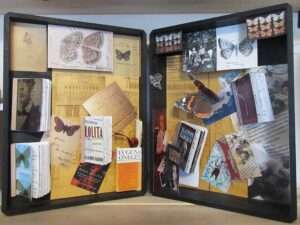
The Blue Hill Public Library will present “Art-Inspired Tableaux” by Liberty, Maine artist Maria King. The exhibition features shadow boxes, based on verbal and pictorial works of authors and artists, on display at the library from May 1 through July 30. The shadow boxes are constructed within the confines of recycled cigar boxes of various shapes, sizes, and character. Each month will feature a different group of pieces with a common theme.
Maria’s enchanting boxes are filled with paintings, sculptures, photographs, film stills,
digitally manipulated images, and a variety of artifacts from different epochs and continents. Her show will be accompanied by a comprehensive catalog with detailed descriptions and sources for about 300 boxes.
During the month of May, the exhibit will concentrate on the literary works of Vladimir
Nabokov, the cosmopolitan novelist born in pre-revolutionary Russia, as well as the Irish
novelist John Banville, whose prose intertwines with Nabokov’s.
June will focus on the poems of love and justice by Robert Stiller, interspersed with the art
of Asiatic masters, and July will feature the works of the revered Polish symbolist painter,
Jacek Malczewski, who was one of the central figures of the patriotic Young Poland
movement of the late 19th century.
Maria comes from Warsaw, Poland, where she developed her great affinity for foreign
languages, literature, opera, philharmonic, theater, ballet, fine-arts museums, and art-house
films.
The exhibition will be available for viewing during library hours through July 30, with
access to artwork in the Howard Room subject to the meeting room schedule. For more
information contact the library at 374-5515.
-
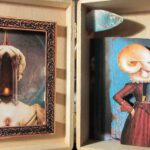
- Intrinsic Questions: The May exhibition presents also transformed works by Joan Proudman, the digital and shadow box artist of Freedom, Maine, and this is one of them, originally called: Fertile Abyss & Two Birds. Maria combined those two works together wanting to convey the information of mind transcending our physicality. The added fishes, as per Chinese culture to be farther explored in the June exhibition, stand for abundance and affluence (in this case of imagination).
-
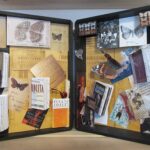
- Vladimir Nabokov: Featuring some works of and on Maria’s favorite author, including his first novel written directly in English, still in France, right before his emigration to the United States: The Real Life of Sebastian Knight, that evoked Maria’s interest in his whole oeuvre, as well as his 70 year long passion for hunting and researching butterflies, specifically the Blues. The Red Admiral butterfly featured in the right panel stands for the butterfly appearing in Nabokov’s third masterpiece Pale Fire.
-
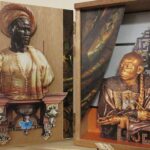
- Ubiquity of the Beautiful: Those two 19th century sculptures by Charles Cordier are combined here with the work by Piet Mondrian (upside down) and the “fabric” by Johannes Vermeer. The sculptor concentrated on beauty of races but for Maria both figures fitted into her Chinese series due to the fact that according to oral tradition the Chinese civilization was founded by Negroid people. This is why the Zhou dynasts (ca. 1100-256 BC), being Mongoloids, started calling their predecessors “black-headed people,” and the name then was adopted for the Chinese, whereas the Caucasians are called “long-nosed people,” which is also reflected in some poems.
-
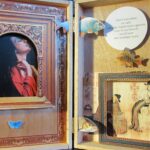
- Beware of Sad Bowels: The title refers to the last verse of a poem Nostalgia by Fan Zhongyan (989-1052), a Chinese scholar depicted here reading from a bamboo slip. The little poem addresses Nina Stiller, Polish singer and dancer, introducing her at the same time to the group of Chinese literati who contemplate at a gnarled pine tree, the motif repeated in many of Maria’s boxes as a tree of significant symbolism, representing virtues of unyielding mind, self-discipline, endurance and fortitude, standing for moral integrity and principles in the face of calamity. Some added fishes serve as counterbalance to possible ‘nostalgic tears.’
-
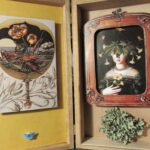
- Delfina I: Showing Lady Biophilia by Joan Proudman who used for her digital manipulation a depiction of Maria di Cosimo de’ Medici by Agnolo Bronzino. The fan (or mirror) by a German Art Nouveau designer Anton Seder was selected by Maria for the life presented on it and for hues, luxury, and elegance. The name Delfina was chosen to immortalize the memory of a Polish friend–a nature lover with a college degree in ecology.
-
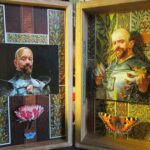
- Knight of Polish Art: Presenting self-portraits in armors of the most prolific Polish painter Jacek Malczewski. In the original painting there is just one butterfly on the painter’s little folk-violin, but Maria added more of them remembering an event in her Warsaw apartment, when the same kind of butterflies hatched in her kitchen and left in a small swarm through the open balcony door of her bedroom, which stays a mystery anyway. Malczewski authored about 2,000 oil paintings throughout his life, 100 of which were self-portraits.
-
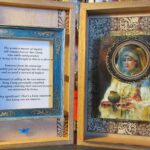
- The Emperor’s Wisdom: The painting Cup of Honey by Konstantin Makovsky, found by chance on internet, became the starting point for creation of the Chinese series that quickly turned into some 40 boxes, and a hand scroll. The box contains one of the poems from the collection Who Will Sound the Gong by Robert Stiller, dealing with the problem of honey defiled by rat droppings.
-
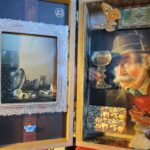
- Cheers: Presenting Tyrolean Gentleman with Rummer (a type of wine glass studded with prunts) by the 19th century German painter Carl Heuser, completing the imagery with a still life by the Dutch painter Pieter Claesz.
-
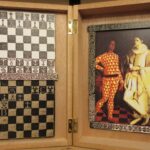
- Doubles: The box Doubles shows a painting by Vasily Shukhaev & Alexandre Yakovlev (called by their college colleagues Twins): Harlequin and Pierrot Self-Portraits. It plays into parodically shaped commedia dell’arte as well as double motifs, observed throughout Nabokov’s various works. Chess–a strong battlefield symbol–represents not only the tensions between Pierrot and Harlequin (winning or loosing the “queen”) but also the game played by the author with his (hopefully) attentive reader or rather re-re-rereader, as Nabokov not only wished to imagine, but seriously advised upon during his lectures on literature at Cornell University or in his letters to editors.
 207-374-5515
  library@bhpl.net


